Monday, April 25, 2011

Blogging and Social Networking - Getting Started

This week I will be working with a group of teachers to introduce an overview of Web 2.0 and Social Networking tools for the classroom and for personal learning.  For more details and dates, click on the Social Media tab above.

Here are some tutorials to Blogger to help you set up your blog and get started blogging. You will post two topics to your blog each week and incorporate some of the Web 2.0 tools into the Google Site and/or blog. Each person will create a blog and post two topics per week.  We will comment on each other blogs.  Adddtionally, we will follow bloggers in our content area and use Twitter (a microblogging tool) to connect with other teachers and content areas. 

Below is an image with a collection of Web 2.0 tools organized into an interactive pyramid of the Bloom's taxonomy levels of Remembering, Understanding, Applying, Analyzing, Evaluating, and Creating.   I am familiar with some of the tools covered in the pyramid.  I found it to be a good visual reminder of both the Bloom's levels and Web 2.0 tools.   We have been exploring several Web 2.0 tools as part of this class.

In the 1990s, one of Bloom’s students, Lorin Anderson, revised the original taxonomy. In the amended version of Bloom’s Taxonomy, the names of the major cognitive process categories were changed to indicate action because thinking implies active engagements. Instead of listing knowledge as a part of the taxonomy, the category is divided into different types of knowledge: factual, conceptual, procedural, and metacognitive. This newer taxonomy also moves the evaluation stage down a level and the highest element becomes “creating.”

Bloom’s Taxonomy can be used across grade levels and content areas. By using Bloom’s Taxonomy in the classroom, teachers can assess students on multiple learning outcomes that are aligned to local, state, and national standards and objectives. Within each level of the taxonomy, there are various tasks that move students through the thought process. This interactive activity demonstrates how all levels of Bloom’s Taxonomy can be achieved with one image.
In order for teachers to develop lesson plans that integrate Bloom’s Taxonomy, they write their lessons in the language that focuses on each level. The United States Geological Survey provides a list of verbs for each level of Bloom’s Taxonomy for teachers to use when developing lesson plans. (Although the list is designed for environmental science teachers, the examples will work for any discipline.)  I thought the review of the pyramid along with the Web 2.0 tools covered in class would be helpful in planning your activities.

Enjoy exploring!

Monday, April 18, 2011

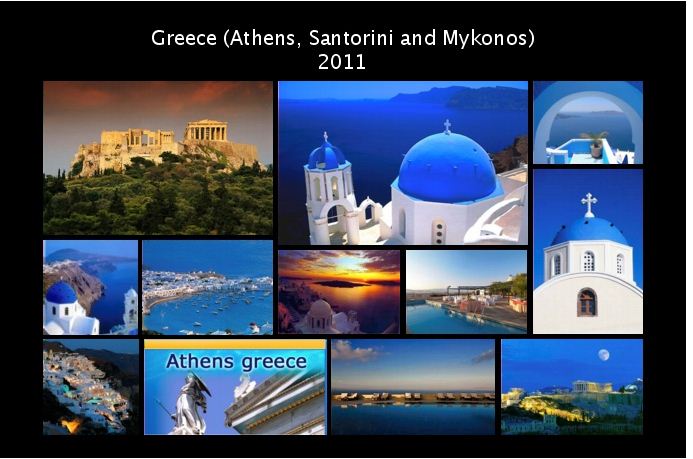
Santorini Greece

We spent the last two day in Athens. The weather has been cool and rainy.  We visited the Plaka then toured climbed the hill to visit the Acropolis. The rain held out until the afternoon.  The kids are having a great time.
This morning we took a five hour ferry to Santorini.  The island is beautiful and the hotel has a great view.  We are off to dinner this evening and plan to spend the day touring the island tomorrow and off to Mykonos on Wenesday.
To see more about the school trip go to http://nrhsgreece.blogspot.com/


Tuesday, April 12, 2011

Greece April 2011

Our school trip to Greece sponsored by Teach by Travel departs this Friday. 
Here is a link to our travel blog


We will be visting Athens, Santorini and Myknos.
Athens: Hotel Stanley
Santorini: Hotel Majestic
Mykonos: Myconian K Hotel travel info

Tuesday, April 5, 2011

Poetry and Video

Class, April 5th - Showcase Glogster Posters
- Google Site (link posters to Google Sites)
- Poetry Project for April
- Prezi Overview
- Other Video editing, converting and posting options

Reminder of upcoming class
Social Networking and Web 2.0 in the Classroom
April 26th, May 3rd, 10th, and 17
th
3PM - 6PM Maynard High School - MHS

Saturday, April 2, 2011

Poetry, ipad and Oprah (April in National Poetry Month)

Each year sophomores in our high school prepare multimedia and movies on their favorite poems. I downloaded the Oprah app for the ipad and the April app is filled with tools to help you express yourself with words, like the "Poetry in Motion" page, where you can create your own poems. Plus, see video clips from guest editor Maria Shriver's interview with poet Mary Oliver. The app also features 16 entries from Oprah's personal journals—11 of them are exclusive to the iPad! I think I will share the app with students next week as they select their favorite poems.


Poetry and the ipad (April National Poetry Month)

More from O
I enjoyed the multimedia interaction while reading and watching Maria Schriver interview Mary Oliver, an American poet who had won National Book Award and Pulitzer Prize. Influenced by both Whitman and Thoreau, she is known for her clear and poignant observances of the natural world. Her creativity is stirred by nature, and Oliver, an avid walker, often pursues inspiration on foot. Her poems are filled with imagery from her daily walks near her home in nearby Provincetown. Oliver has also been compared to Emily Dickinson, with whom she shares an affinity for solitude and interior monologues. Her poetry combines dark introspection with joyous release. Although she has been criticized for writing poetry that assumes a dangerously close relationship of women with nature, she finds the self is only strengthened through an immersion with nature. 


I hope the class enjoys this edition of Oprah's Poetry on the ipad.  It has also inspired me to think about some alternative assignments next week. There are 71 sample poems to watch on the site and you can submit your own poem.


Thursday, March 31, 2011

April is National Poetry Month

What is National Poetry Month?
Inaugurated by the Academy of American Poets in 1996, National Poetry Month is now held every April, when publishers, booksellers, literary organizations, libraries, schools and poets around the country band together to celebrate poetry and its vital place in American culture. Thousands of businesses and non-profit organizations participate through readings, festivals, book displays, workshops, and other events.


30 Poets, 30 Days: Throughout each day during National Poetry Month, a selected poet will have 24 hours to tweet his or her daily insights before passing the baton.  Poem Flow/App   

What is National Poetry Month?: Frequently asked questions about NPM.
30 Ways to Celebrate: A month's worth of poetry activities that any community can take part in.
Celebration Highlights: Reminisce about Academy events and promotions of Aprils past.
  
THIS YEAR'S PROGRAMS
Poem In Your Pocket Day: Join thousands of individuals across the U.S. by carrying a poem in your pocket on April 14, 2011.
Poetry & the Creative Mind: Each April, The Academy of American Poets presents a star-studded celebration of American poetry.
30 Poets, 30 Days: Throughout each day during National Poetry Month, a selected poet will have 24 hours to tweet his or her daily insights before passing the baton.
Poem-A-Day: Great poems from new books emailed each day of National Poetry Month. Sign up for your daily dose of new poems from new spring poetry titles.
Spring Book List: Check out the new books of poetry available each spring.
Poem Flow for iPhones: Available through the iTunes store, this innovative mobile app features daily poems presented as both fixed and animated text.
National Poetry Map: Find out what is happening in your state by visiting our redesigned and updated National Poetry Map. Massachusetts http://www.poets.org/state.php/varState/MA


Use Technology, Collaboration, and Creativity to Inspire Students for Poetry Month
Poetry Lessons, Ideas and Resources from Edutopia
http://www.edutopia.org/technology-collaboration-poetry-month-gail-desler

If you have been looking for lessons, new ideas and resources, and maybe a little inspiration to ignite your celebration of National Poetry Month
Read/Write/Think – I’ve been a long-time fan of this NCTE (National Council for Teachers of English) site and have come to expect outstanding teacher-tested, research based resources like the ones posted for National Poetry Month. I recommend checking out the “interactives,” such as Diamonte Poems or What’s an Acrostic Poem? and then move on to sample some lessons, such as Poetry Portfolios for your primary students, Composing Cinquain Poems with Basic Parts of Speech for elementary students, or Is a Sentence a Poem? mini-lesson for secondary students. In addition to hosting the Read/Write/Think site, NCTE also posts a National Poetry Day page with podcasts from last year’s entries.  More links


Prom - Choose your Adventure Video

Earlier this month I wrote a blog post about learning from others on twitter. Pat Larkin @bhsprincipal at Burlington High School, and Greg Kulowiec @gregkulowiec from Plymouth tweeted about creating 'Choose Your Own Adventure' using YouTube/Spotlight, to learn more about the technique go to  "How to Make an Interactive Lesson Using Youtube" On the site is an example of a "GMAT Choose Your Own Adventure".

Two students in my graduate class (Amanda and Craig) created Adventure videos for math.

A student in my high school, Courtney created an Adventure Video on Prom Choices. Although this video was not part of the contest, it was an alternative assignment, allowing students to further explore the choices and consequences of drinking and driving.  The assignment was motivated by the  Dance Don't Chance video contest that is part of the Executive Office of Public Safety and Security (EOPSS), in partnership with the Registry of Motor Vehicles and the Department of Public Health that aims to make the prom/graduation season safer for teens on Massachusetts' roads. 
The Adventure Video allowed Courtney to create and link several videos together to show students have choices to make around drinking and driving.  Her message, drinking and driving is illegal and stupid. I would have to agree.

It was great to take an idea that Greg tweeted and blogged about and apply directly to the classroom.
I believe the class plans to incorporate more Adventure videos into their assignments.